FantasyCon 2014

This year FantasyCon, the British Fantasy Convention, is in York, next weekend in fact, and there are lots of top guests of honour and many panels and shenanigans over the three days. After a very busy Nine Worlds, I’m looking forward to a much more relaxed FantasyCon.

And yet, somehow I’m now on a panel on Friday at 7pm:-

7.00pm – Podcasting for beginners
What makes a really good podcast? Which are the ones you should be listening to? How can you make your own?
Peter Newman (m), Alasdair Stuart, Emma Newman, Jennifer Williams, Stephen Aryan

There are lots of great panels going on, but the other thing I would like to point out that I think will be special, and you really should attend, is the Super Relaxed Fantasy Club on Saturday night at 9pm. There will be several readings from authors and a very interesting interview, more info soon.

The full schedule is here

Apart from that I’ll be wandering around, sat in panels, or in the bar I’m sure. Say hello if you see me.

My Nine Worlds Experience

Nine Worlds is a new and very different convention in the UK to many of its predecessors that have been around for a long time. Rather than focusing on a particular genre TV show, or medium such as comics, it covers everything. There were over 30 different tracks and I was co-running the podcast track with Barry Nugent from Geek Syndicate. A quick look at my inbox shows a couple of hundred emails sent by Barry or me, to the organisers, moderators and panellists. We had two panels each day and as this was the first year of doing a podcast track, we both wanted to be there to make sure the panels went well and we were on hand throughout to help with any issues. For example not being able to get into the room on Friday or the microphones not being switched on. A quick chat with the organisers and every issue was resolved quickly, so I have to take my hat off to them for all of their help and everything went according to plan.

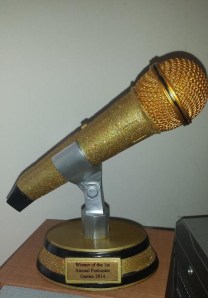
Bu7OCoQIgAAUuu-The highlight of the podcast track for me was the two panels we had on Saturday. The first Democratisation of Podcasting and New Media was totally fascinating and Scott’s interesting presentation laid out the evolution of media. He showed how the world has changed from a place where we receive the news from a few limited outlets to what we have today, where individuals, other than journalists, are creating the news and reporting on it, sometimes live from the scene. After that was the First Annual Podcaster Games, where two teams of three podcasters went head to head to test their geeky knowledge. The quiz covered all areas from TV to comics to film and everything in between. We had buzzers, we had trophies, we had lots of angst and two brilliant Games Masters who ran the quiz (Gavin and Dan from the Sidekickcast) who took no cheek from the contestants. Some of whom were cocky to begin with but that soon faded when the questions fell outside their normal wheelhouse. The quiz was a lot of fun, we had a lot of laughs and everyone in the audience had a great time. The winning team went home proudly holding their trophies aloft.

So on all three mornings of the convention I was busy, but on Saturday afternoon I sat on a panel about Likeable Bad Guys from All the Books track. I think it went fairly well, everyone generally agreed with one another so there wasn’t any controversy. I was very nervous, didn’t ramble too much and managed not to offend anyone or puke, so overall it was great.

Saturday night I also did my first public reading as part of the New Voices segment on the All the Books track. I read part of chapter 1 from Battlemage, which is out next year from Orbit books. I was horrendously nervous, felt very sick beforehand, stumbled a couple of times during my reading, but I didn’t rush and got through it without too many mistakes. I think it went well and the crowd of fifty plus people seemed to like it. I had friends and supporters in the crowd which helped too. At this point several people have read my book, but this was the first time I’d essentially shown other people how I interpret it, how I see and hear the characters and the rhythm of the sentences and dialogue in my head.

I managed to find time to go to a few other panels, one on Writing LGBTQ+ Characters in SFF, and one about writing the inhuman, where four writers talked about what makes a character inhuman and how they get into that mind space.

There were a lot of friends at the convention that I wanted to spend time with but I didn’t have enough hours in the day to talk to many of them. They were busy and I was either busy organising panels, going to a panel, grabbing something to eat or running from one place to another. Thankfully at my next convention, Fantasycon in September, I’m not running anything and am not appearing on any panels so I will hopefully have more time to catch up with people I missed at Nine Worlds.

Overall Nine Worlds is the most inclusive convention I’ve ever been to. Everyone was made to feel welcome and the organisers went out of their way to accommodate everyone from every walk of life. There was a lot going on, dare I say perhaps too much, because while it was nice to have so much choice it meant I missed a great deal because so many things were happening at the same time. Other conventions suffer from having too narrow a focus, so I sometimes find I’m only interested in 25% of the available panels whereas with over 30 tracks it was the opposite. I guess it’s trial and error, finding which tracks prove popular and which don’t and then adjusting the tracks for the following year accordingly.

The date is already set for Nine Worlds 2015 and tickets are on sale. I’ve no idea if I’m going to be there yet, simply because 2015 is going to be very busy for me with book 1 coming out, editing book 2 and writing book 3. I suspect I will be at a few conventions but I’ll decide a little closer to the time.

Real Ale: Yorkshire Blackout – The Great Yorkshire Brewery

I’ve not done of these in a while. So for those who are new to the website, as well as posts about writing, I also write about comics, TV, films and real ale.

Yorkshire Blackout“We’re right chuffed with our porter. This 18th century London beer style is brewed with 100% English ingredients and showcases the delicious flavours of chocolate and vanilla – by ‘eck it’s addictive.”

As I’ve probably mentioned once or twice before, I’m a fan of tasty porters. I find most stouts too heavy and too strong and I need a lie down after one, but porters lay somewhere in that nice middle ground on the ale scale.

This is another old style modern real ale, from an 18th century recipe. One of my other favourites, Black Gold from the Copper Dragon Brewery in Skipton, is another of those ye olde discovered recipes and there is some common ground between them in terms of taste. Yorkshire Blackout, as the name suggests, is completely black like a pint of Guinness but it’s not a heavy drink and it’s very different in texture, plus it doesn’t have much of a head. Strong flavours of chocolate come through immediately and it took only a few sips for the after-taste of vanilla to come through as well. It smells of vanilla but it’s not overpowering, so it doesn’t taste like you’re drinking a melted lump of ice cream. The balance of flavours is actually just right for me, not too bitter or sweet, and despite being 5% it was still a very fresh and tasty drink. It’s the kind of pint I’d have with a traditional hearty meal, like a steak pie and chips or bangers and mash.

The Great Yorkshire Brewery (previously Cropton Brewery) which is located in Cropton was founded in 2010 and they offer a range of beers from lagers to porters but also ciders. There are still Cropton beers on the website so they might be offering beers under the two brands or in the middle of a transition. They do offer brewery tours of their facilities and more information is available via their website. The brewery is also producing seasonal ales using local produce starting with Lavender Blonde this August using local Yorkshire lavender.

Take a look at their website as it has more information about their beers, forthcoming events, an online shop to buy beer and merchandise and the latest news on their blog. Earlier I mentioned matching beer to food and there is also the opportunity to buy a Beer and Food Matching evening as a gift via their website. I think this is a brilliant idea and I’m seeing more of this sort of thing being offered all over.

How I Found an Agent – Part 2

As mentioned in Part 1, this is a history of how I found an agent and later a publisher. One of the reasons for writing this is to try and dispel the myth that continues to circulate that in order to succeed in getting published you need to have connections and friends in the business. This is not true and I am proof of that. There are many other examples out there as well. I was picked out of a slush pile.

This post will focus more on my specific approach to contacting an agent, detailing our initial messages back and forth, my initial submission email, and what happened after.

Part 1 details my long history of the many years I spent trying to get an agent and the many rejections I received from agents. What I didn’t mention or highlight, but if you are a writer who has been rejected then you know it already, is the agony. The pain of rejection, the fear, the constant questioning of self and your ability, the depression, the misery, the ups and downs and the tears. You’ve poured countless hours into something only for someone to say no. It hurts. It hurts a lot. If it doesn’t hurt then I would be worried because it suggests you don’t care about it.

Also if you are a friend, family member or partner of a writer then you’ve gone through all of this with them, usually for years. I sympathise and I thank you all for your patience and understanding, as it is not easy. Being rejected a lot takes a toll, sometimes physically, sometimes mentally, but it always hurts and it is incredibly difficult to get back up, dust yourself off and try again. But I did it because the alternative was to stop writing and stop trying, and that was never really an option for me.

So, all of that brought me to a point in my life when on 28th April 2013 I sent out an email to an agent with the first three chapters of my epic fantasy novel.

Writing a synopsis is painful. I hate it with a passion. Trying to sum up 130 thousand words in a page or two is difficult. I still don’t like it. Now I had to take that and cut it down even further and try to explain what the novel was about in a short email. I didn’t tell her what happens in the novel and list the events, e.g. Jim goes on a quest to find a magic sword, going from Blahdeblah-land to Zibbleland, because that doesn’t tell her what the story is actually about, only what happens. Is it a coming of age story? Is it a revenge story? Is it a romance? Sometimes you may not even know what the novel is about until you’ve written it. You may have an idea, somewhere in the subconscious part of your mind, or you may not. That may come out during the writing process.

In my email I described some of the world, gave very brief info on the points of view, highlighted that I’m deeply embedded in the fantasy genre, so if there is something that looks like a trope, it’s probably there on purpose because I want to take it and do something new with it. Tropes can be twisted, remade, repurposed. For example, if I said the novel included a grumpy and powerful wizard, a dangerous warrior and a noble, all tropes in themselves, am I talking about Lord of the Rings, or Joe Abercrombie’s First Law trilogy?

Below is a copy of my original email to Juliet Mushens of The Agency Group. I’ve taken out a couple of bits, to avoid spoilers and because the title has changed several times since.

Dear Ms Mushens,

Please find attached for your consideration the first three chapters of my epic fantasy novel, [title].

It is a story about power and the death of magic. I wanted to explore how different people react to power, be it sovereign or magical, and look at how they cope; from people who inherit it against their will, to those who covet it and will do anything to keep it.

Set against the backdrop of what is in essence a first world war, the story is told from three main viewpoints, the leaders of the defending nation, which allowed me to explore the politics and strategy, the front line squaddies and their daily challenges, and the Battlemages, powerful magical outsiders who are both feared and respected. A fourth minor viewpoint focuses on espionage and attempts by undercover agents to unravel the war away from the battlefield.

The title of the novel references several strong themes in the story, including [removed to avoid spoilers].

I’ve been a fantasy reader all my life, and have knowingly used several fantasy tropes, but have hopefully given them an interesting and often tragic twist. The story contains strong women, black humour and it subtly looks at several issues.

[title] is 130 thousand words long, the first in a planned series of three, but each novel is a standalone story, with some threads that carry over into the next.

Below is a short blurb, and if you require any more information please do not hesitate to contact me. Thank you for considering my work.

Yours sincerely

Stephen Aryan

 [Below are Juliet’s comments]

Stephen’s covering letter was succinct, punchy and interesting. He summed his book up in a brief way, he nodded to some things I like – realistic portrayals of women and black humour – and his blurb really made me want to read the book. Battlemages! Spies! A psychotic and powerful magician!

People often think they have to make their cover letter whacky and show their personality, but often those can come across badly. Stephen’s letter was professional and told me everything I needed to know.

I was hopeful when I turned to the first three chapters and he had me from the get go. He had drawn his world well – it felt familiar yet fresh – and his characters were intriguing and well-rounded. Often I feel that novels start before they should: you get pages of the character on a journey, or waking up, or starting their morning routine. But the novel threw us right into the action, meeting a battle-scarred man named Vargus and managing to convey a lot about the backdrop to the novel through action and dialogue. It was polished and compelling.

On 16th May 2013 I received the following response from Juliet.

Hi can you email me the full ms please?

I was excited and nervous and scared. But this wasn’t a yes. This was a request for a bit more. I’d read countless stories from people who have sent in full manuscripts and still been rejected. I’d read there are lots of reasons for this, including the first three chapters are sometimes the best and most polished and the rest of the book isn’t ready. Another reason for rejection is that sometimes people send in a submission and have only written the first few chapters in full and none of the rest of the book. This is a horrible and stupid thing to do.

I can sort of understand the logic, the fear of time wasted writing a whole book only for it to be rejected. So why bother? Therefore, only writing the first few chapters saves time, right? Because if they like the first three chapters, then you can write the rest once you get a thumbs up and that will be fine, right? Wrong. Totally wrong. Finish the book. Doing it this way will piss people off, and it may burn bridges in the future. The industry is small, the odds of being picked up are smaller and there isn’t an endless supply of agents, so don’t piss them off and reduce your odds even further by doing something stupid.

I kept my email back to Juliet short, professional and to the point. She wasn’t my friend because of one email and this is still business, so I treated it like any other email for my day job with a new correspondent. If she needed anything else I asked her to let me know.

Below is a copy of the email that I sent on 16th May 2013. I sent it off, knowing it could be months before I received another reply, so I tried not to check my email every ten seconds and get on with my life.

Dear Ms Mushens,

As requested, please find attached a copy of the full manuscript for [title].

If you require any more information, please let me know.

Regards

Stephen Aryan

[Juliet’s comments]

When I get to read manuscripts depends a lot on my schedule. Some days I get absolutely no reading done, sometimes I have lots of plans in evenings and weekends which also puts me behind. But luckily for Stephen, I fell ill with a nasty cold and couldn’t go to work. I didn’t feel well enough for daytime TV, so I thought I’d have a quick flick through the full manuscripts I’d been sent, and Stephen’s caught my attention.

Something unfortunate happened which turned out to be lucky for me. A few days after I sent in my full manuscript Juliet became ill which meant she had to stay at home. As it happens it meant that she read my novel in one day. On 20th May, just four days later I received a reply from Juliet, posted below. Again a few bits have been removed to avoid spoilers.

Hi Stephen,

Thanks so much for sending me this. I really, really enjoyed it. You have created a richly imagined fantasy world, which pays homage to many of the greats yet still feels fresh and original. I loved a lot of the characters too (Vargus is my favourite) and the idea of [spoilers].

I think it needs work – the pacing lags in places, your women need depth and more prominence, and Balfruss needs to be fully realised – but I’d be keen to represent you and work with you to sell this. You show a gift for storytelling that I see only rarely, and this kept me occupied on a day of being in bed ill which is no mean feat!

Are you able to come to London at all this week or next? I’d like to chat in person about my editorial thoughts for shaping the book and answer any questions you have.

All best,

Juliet 

[Juliet’s comments]

I don’t call in many full manuscripts a year, but those I do call in are often passed on for similar reasons – a lack of pace, a story that plateaus, characters I stop caring about, or just feeling very rushed compared to the first three polished chapters. But Stephen showed a real gift for storytelling. Through a 130,000 word manuscript he sustained my interest, he made me care about the characters and he made me invest in the stakes of the novel. I found myself noting down my thoughts as I read, where it needed depth, where I thought he needed to slow down, or cut, or expand. I only ever do this if I am very engaged with a book. By the end of the novel I felt very excited about the book. I could already visualise who to submit the novel to, and was confident in placing it with a publisher.

I always like to meet an author before we start working together. If I had sat down with Stephen and said, ‘I think it needs x, y and z’ and he had said ‘no way!’ then we would not have been the right partnership. I wanted to make sure that we would get on well together and have a shared vision for the book. Luckily, we were very much on the same page – Stephen was receptive to my comments and we came up with a plan of action to start work on them. I also liked Stephen, which helps! I felt we’d get on well. Working with an agent has hard times as well as good, and it’s important to feel like you are a team.

I took a day off work and went down to London to meet Juliet. We met at her office and talked through her comments. We went back and forth on the ideas, I made notes and came away feeling energised and keen to make the novel better.

In January 2014, Juliet and her assistant Sarah felt the novel was ready to go out on submission. By this point I had revised it several times.

[Juliet’s comments]

Stephen worked really hard on the novel, and in the meantime I’d been pitching it to a couple of publishers. One in particular, Jenni Hill at Orbit, was very excited to see it, and she ended up buying the trilogy. But that’s a story for another day…

Battlemage, the first in a trilogy, will be published next year by Orbit. It will have been fifteen years since I started trying to get an agent and I will be 38 years old.
How I Found an Agent – Part 1

Sadly the myth continues to circulate far and wide around the internet that in order to get anywhere in publishing you need connections. You need to know people who can grease palms, open doors, give you the secret handshake that will get you an agent and then a publisher. This is complete and utter nonsense. It is not true at all. I can’t stress how much crap it is without using a lot of swearing to emphasise my point in the strongest possible terms. I had zero connections in the industry. I was picked from a slushpile. Also, the myth cheapens all of the hard work and effort each writer has put into their work over the years and that offends me.

Below is my two part history of how I found an agent.

I started submitting to agents in 2000. Yes, fourteen years ago when I was in my early twenties, I’m now 37. I had written an epic fantasy novel. I thought it was good, I edited it, had a couple of friends read it that encouraged me and I sent it off. Back then the internet was in its infancy. Agents were not online, there was no social media, no instant way to communicate as we have now, and if you were lucky an agency might have a website with an email address but they didn’t accept online submissions, it was a paper only world.

Every year a weighty tome, The Writers’ & Artists’ Yearbook, was and still is published which lists all agencies, agents, genres they accept and their submission guidelines, such as number of chapters or words, and you always had to include return postage for your material with a self-addressed envelope. I found the few agencies that accepted fantasy, because there were not that many, followed the instructions and sent it off. Then comes the awful waiting for three or more months. Initially the instructions said it was bad practice to send it to multiple agencies, so I followed the rules and sent it to one at a time with three months or more wait every time. Then they eased the rules slightly and you could send to multiple agencies at the same time as long as you mentioned this in your letter, so I did that. I received a lot of rejection letters over the course of a couple of years.

However, during that time I remained undeterred and I started work on a sequel. I received more rejection letters in the meantime for the first book. Now I had a book no one was interested in and a sequel that no one had ever read.  I never knew why they didn’t want the first book because the material was returned without any comments. There was just a standard printed slip with my name typed or hand written at the top and they returned my first few chapters. Not knowing was sometimes worse than the rejection itself. If I knew what needed improving then I could work on that, but I didn’t.

I’m not going to document every aspect of my writing, but briefly, in addition to writing  novels I attended writing events, joined writing forums when the internet grew up a bit, took part in online communities, reviewed other people’s submissions in return for a review of mine, did everything I could to try and improve my work. I also attended a lot of events and keenly listened to all of the advice from writers and those in publishing.

After the two fantasy novels went nowhere I wrote a science fiction book about genetic manipulation and designer babies. I had friends read it. I edited it a lot and then sent it out to agents, after buying the new W & A Yearbook. I received more rejections over the course of many months. So I wrote a series of horror short stories and a connected novella focusing on vampires and werewolves. On a whim I wrote a fantasy short story, posted it online on a writing forum and received feedback so ridiculous I immediately left the forum. Online communities are sometimes a really bad and unhelpful place and this was one.

In 2006 I wrote another epic fantasy novel, I worked on it, then sent it out. I was rejected. Again I never found out why. I wrote screenplays and sent them off to competitions that had an open door policy. I co-wrote episodes of favourite American TV shows that also had open door policies. My friend and I received words of encouragement and praise from those involved for our efforts, but we were ultimately rejected. I pitched comic book ideas to a US company, got my first paid bit of comic book work and then a little more. It seemed to be going well, then the company went into an internal spiral and it went nowhere. So I wrote and self-published a superhero comic, a pastiche and callback to some of the older comics I loved that was self-aware of its heritage. The comic book writing has continued, but I’ll leave that for another post.

In 2008 I started work on a contemporary horror novel with strong Lovecraftian themes. I revised it, had trusted people read it, posted the first few chapters online on a writing community and received good feedback and useful criticism. I revised it again and again. I left it alone for a few months then I came back, chopped out about 30,000 words and tightened it up. I reposted it and received positive feedback from new people. I sent it off to agents that accepted horror, using the new W and A Yearbook, and I was rejected, sometimes with silence, as some no longer returned material and just recycled it, sometime with a standard rejection slip.

In 2009 and 2010 I wrote a modern day crime thriller, seat of your pants, action novel. I saved up my money and even though it was expensive I attended the first Festival of Writing in York in 2010. I was scheduled to have two 1 to 1 meetings with people at the event. The first was with an author who told me the novel was good and I should send it to her agent with her recommendation. The other sadly didn’t happen as the agent cancelled his attendance at the last minute. I felt encouraged. I sent it off to a few agents, including the author’s agent, as she continued to encourage me. Sadly it didn’t land anywhere, I was told in person by one agent that it was too vanilla, it was rejected a few times and nothing happened.

I returned to my first love, fantasy, and wrote another fantasy novel in a brand new world. I did everything the same as before. I rewrote it several times, I edited it, then I let it sit for months, then came back fresh and rewrote it with fresh eyes.

In the meantime the internet and the world had moved on. You could find individual agents online. You could see what they looked like, speak to them via social media, listen to them speak at events, find their individual (not the whole agency) requirements for the genres they liked and send submissions electronically. No more self-addressed envelopes, no more half a tree going out the door every time, no more postage costs.

I did my homework. I looked at which agents were online, what they wanted, what deals were announced on The Bookseller website, what the agents asked for, how they prefer to receive the content and how to address them (Dr, Mrs, Ms, Mr, Miss, Rev etc). I was on social media so I eavesdropped on a few of them online, tried to work out what kind of person they were and get a feel for them. I attended more events and listened to them on panels. Based on my research I scratched a few off my list of potential agents. For the first time ever in my life, if successful, I could choose who I wanted to work with, possibly for decades. I needed someone on the same wavelength. Someone that was hungry, passionate and someone I thought I could work with and, very important to me, someone I thought I could get on with personally and have a long professional relationship.

After another edit, I carefully read her submission guidelines. I jumped onto one of the several #askagent things that crop up on Twitter and asked her preferred form of address (it was Ms). Then I wrote my email submission and triple checked my spelling and that I had met her submission requirements.

On 28th April 2013 I sent out an email to an agent with the first three chapters of my epic fantasy novel.

On 16th May 2013 I received a reply.

My Panels at Nine Worlds 2014

A short list of where I’ll be during Nine Worlds in a couple of weeks time.

Between 10am and 1pm on all three days I’ll be keeping an eye on the Podcasting Track which I’m co-running with an old friend, Barry Nugent, from Geek Syndicate. Barry and I go way back, almost to the dawn of UK podcasting. I think we’ve come up with some great panels and I’m particularly looking forward to Saturday for both the TED style talk from Dr Scott and the epic geek quiz. I think they’re both going to be brilliant fun.

On top of that I am also appearing on a couple of panels listed below.

Saturday – All The Books Track

Likeable Bad Guys
Loving you is easy; explaining you is so hard
1.30 – 2.45pm
County C&D
We love to hate them, we hate to love them: from great one-liners to a sympathetic backstory, from the evil laugh to villian-fabulous fashion: what makes bad guys soooooo good?
Panel: Ed Fortune, Rochita Loenen Ruiz, Stephen Aryan, Anna Caltabiano, Den Patrick

Saturday – All the Books Track

New Voices: the Class of 2014 continued!
10.15pm – 11.30pm
Royal B
More fun and fast-paced readings from the very best new writers.

I will be doing my first public reading ever. I’ll be reading from Battlemage, which is due out next year from Orbit. Not nervous at all. Nope. No. Not me. Oh lordy.

Sunday – Podcasting Track

The Power of New Media
11.45am – 1.00pm
This interactive roundtable panel follows on from Saturday’s talk about new media. Four podcasters will discuss and explore with the audience the growing power of new media and the rise of the everyman journalist.
Speakers: Barry Nugent, Emma Newman, Stephen Aryan, Scott Grandison

Barry, Emma, and Dr Scott, my co-host from Comic Book Outsiders will sit down to talk about podcasting, new media and where it’s going. Hopefully we’ll get the audience involved and make this an interactive session where audience members come with their own questions and ideas.


Beauty and the Beast – Month 5

Ep.17 – Down to a Sunless Sea – On the whole this episode was just ok. In short, an old flame of Catherine’s who was overbearing and controlling, turns up after several years and wants to reconnect with her before he dies. He’s supposed to be a changed man but slowly we start to see the signs that all is not well and he’s just as bad, in fact much much worse, than he was before. Then it all goes wrong, she gets into trouble and Vincent has to save her again. So, on the whole despite some changes, pretty formulaic. What’s most interesting to me is, long before Vincent and Catherine talk about this man, long before she even mentions it to Vincent, he has been having nightmares, and then waking flashes of the same thing. This vision of being pursued through the woods at night by someone persists and he tries to warn Catherine. In the end it all comes full circle, Catherine does end up running through the woods in terror, just as he saw. They fudge how he knew, but part of me today is thinking, wait, so does that mean that no only does Vincent have a strong empathic link with Catherine, but he’s also having visions of the future? He’s able to see the future? That is pretty cool and I hope the explore this a bit more but I have a feeling they don’t.

Ep. 18 – Fever – Mouse discovers a pirate shop full of treasure under the city. Greed infects the whole of down below and people who had nothing suddenly have the chance to use the treasure to buy new stuff they need but also want, instead of relying on stuff they find, or borrow, or are given.  All of this is focused through Cullen, one of the senior adults on the council who does some pretty nasty things for money, but we also hear about his life before and what made him leave the world above. Like most of them it is a tragic story full of heartache but he is the worst infected. There’s an odd moment when Catherine says it’s a disease from my world, as if the people down below are a different race of people. Not a bad episode, and the best bit about it was probably the cameo of some guy reading a George RR Martin book in a diner. It might even be him for all I know, but I spotted it straight away. A nice episode to get a bit more background on one of the supporting characters but I’m still waiting to find out about Winslow played by the great James Avery.

Ep. 19 – Everything is Everything – In this episode Catherine and Vincent try to help a gypsy boy clear his father’s name who has been wrongfully exiled from his people. Catherine is shown up by a street-wise kid with a mouth on him, but eventually she manages to win him over and prove that she’s a good person who is only trying to help him. The episode is so so and a little predictable, but it’s sweet and touching, and there are some interesting moments such as when the boy first comes face to face with Vincent. He doesn’t freak out, scream and run, but is just curious like most children. Yet again there is an echo of being an outsider, someone different from everyone else in society, living on the fridges and not being accepted.

Ep. 20 – To Reign In Hell – The show has always had more freedom than others. It’s not a cop show, so it is not always the same thing every week in terms of structure. There are recurring themes, being a modern day twist on an old fairy tale, but in general it has a lot more scope for stories than some TV shows. That being said this was by far the weirdest episode yet. Laden with quotes, visual cues to mythology, heck even the title of the episode comes from literature and is quoted and explained by a character in the story, this felt like a completely different story. A giant, yes a real giant who is never explained, kidnaps Catherine to take her down into the underworld, a red and hot and hellish place, where a cast out character now rules. He even wears a mask that makes him resemble the Phantom for cripes sake. So many things going on here, Vincent punting a narrow barge across a river in the underworld, a quest to save a damsel in distress, there was just too much. I felt bewildered and that someone had thrown everything at the wall and most of it had stuck. Also I had to go and open my big mouth a few episodes back about wanting to know more about Winslow. We find out a little more about him and then of course this is his last episode. All in all, a very jumbled and visually exciting episode that generally left me feeling a bit cold this close to the end of the first series.

Ep. 21 – Ozymandias – This episode was more on more familiar ground. Elliot Burch is going to build a giant mega huge tower, because he has a big ego and because he wants to and because he thinks he can do whatever he wants. Unfortunately the deep foundations necessary for the building threaten the top layers of the underworld which mean Vincent and everyone else would have to relocate even deeper and rebuild their lives again. Father is a little bit more dramatic saying it’s the end of their world, but to be fair to him there doesn’t seem to be any sites as suitable as the one they currently live in. Meanwhile Catherine is struggling with mixed emotion about Burch who is both evil and generous and he appears to care for her. Their interactions awaken emotions for both of them and there’s a marriage proposal. The resolution for this episode was quite interesting and unexpected. It also showed how much Catherine was willing to sacrifice for other people, especially Vincent, which is weird given what happens in the last episode.

Ep. 22 – A Happy Life – There’s been no mention of Catherine’s mother up to now, but we quickly learn in the first few minutes that she died when Catherine was young. On the anniversary of her mother’s death Catherine becomes emotional, sees how her friends are getting on with their lives, having families and apparently living the good life and she begins to feel alone, bereft and seeks psychiatric help to unravel and resolve her issues. What follows is a bit jumbled, but essentially Vincent is both the root of her loneliness and the best thing in her life so there’s lots of emotional wrangling before she decides something has to be done and she can’t go on like this. Vincent tells her to walk away from him forever, to go and live her life and be happy and there’s a lot of angst and heartache. Then it turns out her friends who apparently have perfect lives envy her life in the city. In the end Catherine decides she can’t live without Vincent and comes back to the city as she cherishes what she has even if she can’t be with him as a normal couple. Despite what I felt was rather a flat ending to the series that didn’t have a lot of punch there were a few good scenes, such as those between Catherine and her boss Joe. Once again it’s a rare male and female friendship without any romance and some great dialogue which gives a sort of shorthand about their relationship. I had kind of hoped that at the end of this season their relationship would progress a bit more, but apparently we’re not there yet.

Looking back at my comments about the last few episodes, I think the end of season 1 tailed off a bit. However, overall I have been continuously surprised and amazed by this series for many reasons and it has proven to be far better than I remembered with my rose tinted glasses of memory. I am now a proud owner of the whole three season box set so I will continue to watch the rest at some point, but probably at leisure without a self-imposed schedule.

A great bonus I found at the end of watching season 1 was a documentary and a short interview with Ron and Linda, which looked fairly recent in fact, with them talking about the series, favourite episodes, the writers and the style and dialogue of the show. Also, an added bonus which will spur me on to watch the next two seasons is they have done short introductions to certain episodes in series 2 and series 3.

Summer Holiday

In a few days I’ll be off on my annual summer holiday for a much needed week of rest and relaxation in the sun. It will give me a chance to catch up on my reading (see previous for my list of books I’m taking away), my sleep and to recharge the batteries because when I get back it’s going to get very busy for a while.

In August I will be attending the second annual Nine Worlds event. I’ve posted about it before and after hearing such great things about it from last year I’m really looking forward to it this year. Not because of my small role in helping to organise a small part of it (the podcast track which I’ve running with a friend), but because of the many other tracks that are running at the event and the variety. Conventions are typically quite linear, organised around a particular TV show, or film, and to be fair sometimes there are cross TV show conventions, where a few guests from two or three shows.

Book conventions often bring together authors from related genres and sometimes there’s a tangentially connected guest from left field, but by necessity really events are quite focused so people know what they’re getting when they buy a ticket. Nine Worlds is the first convention of its kind that I’ve seen in the UK. One that has a track for books, and you can spend all weekend at that one, but if you want to jump over here for a few hours and do something else you can. So I’m going to jumping between monitoring the podcasting track, attending panels on the book track, dipping in and out of the games track, and possibly the gaming area, browsing the dealer room and probably dropping in on a few other panels here and there. I’m also appearing on a couple of panels, one for the podcast track and one for the book track, but I’ll post more info closer to the time.

Another reason I’m excited about the convention is because I don’t get down to London very often, maybe once or twice a year, and it will give me a chance to meet up with a lot of convention friends I only see when I’m down there. I spend a fair amount of time talking to them online via social media and email, but it really isn’t the same. So I’m really looking forward to sitting down and chatting over a pint or two, and meeting up in person with some new people I’ve chatted to online for the first time.There are too many to name individually, but I’m sure there will be photographic evidence and lots of blog posts after the fact.

So at Nine Worlds there will be copious drinking, hopefully a few games of Cards Against Humanity and I’m taking my Magic cards and might get to battle a few people with those, although I am incredibly rusty so it will take me a while to get back into the swing of things. When I say rusty I’m not being modest, I mean it. The last time I played Magic was when it first came out, maybe ten or twelve years ago, so I definitely need to practice a bit. Overall I think it’s going to be a cracking weekend but utterly exhausting.

Thankfully it’s nearly a month until the next convention, Fantasycon in York, so I will have plenty of time to recover. I’m not running anything at that event, so it should be a bit more relaxing, but no doubt there will be more drinking, meet-ups, panels and organised chaos.

After that it’s all quiet for a while, so I’ll be head down grafting away on book 2, then making a start on book 3. As tiring as the events will be they’re actually really good for invigorating me, and they make me want to get back to my own writing. I think it has sometimes to do with being around so many other creative people. Even though I could away exhausted it’s a good thing. So, I’m off soon, have a good summer holiday and I’ll probably see some of you at Nine Worlds next month.


June General Update

This month seems to be about podcasting, more or less.

For a few months I’ve been busy working away in secret with Barry from Geek Syndicate to plan and coordinate a podcast mini track at the forthcoming Nine Worlds event in London this August. Our panels will run from 10am to 1pm on all three days and the panel descriptions and more information is available here.

One of the guest speakers on the podcast track is my podcasting partner in crime, Dr Scott, who will be sharing his wisdom. We’re still recording together, and we might even try to do something live and in the same room at Nine Worlds, although the last time we tried that it was weird being able to make eye contact with him.

This is the second year of the event, after a highly successful first year with an event that encompasses all sorts of weird and wonderful ideas. It really is unlike any other event as it combines so many different things. More information on all of the tracks is available here.

Last week Pete Rogers and I recorded another episode of our Bags of Action podcast where we discuss an action film. This time it was the 1989 classic, Next of Kin starring the late great Patrick Swayze. You can download a copy direct from the website here, or search for it on iTunes.

Apart from that, I’m busy doing the usual things, so there’s not much to say. I’m editing book 1, Battlemage, then I will jump back to working on the first draft of book 2. All of the book stuff still seems so far away in the future, which is great in some ways, as it means I have ages to write books 2 and 3. In reality once I parcel up the time required, it’s not that long and I’m sure the time will just fly by between now and next October. In which case, I’m off, I’ve got too much to do and too little time!


Blog Tour: Writers Blog Tour

Below is a post with a few questions and answers as part of a writers process blog chain going around the internet. I was nominated by Ruth Booth on her website and so at the bottom I’ve highlighted three more people who at some point in the future may post a similar blog. You get the idea.

What am I working on?

Currently I’m hip deep in structural edits for Battlemage which is due out next year in October from Orbit. When that’s done I will switch back to working on the first draft of book 2, while somewhere in the back of my head I will start knitting together the strands for book 3. I’m also nudging along a couple of comic book projects, both of which I’m co-writing with Pete Rogers. The first is a SF contemporary thriller graphic novel, and the other is a fly by the seat of your pants action thriller. A while ago now, I wrote a game for a computer games company, and that’s currently in the testing phase, so every now and then I play through sections of the game and send in my notes. Then a few weeks later download the next version and start all over again.

How does my work differ from others in my genre?

This is a really tough question and there’s no easy way to answer it. In the future I suspect other people will point out the similarities between my work and other fantasy writers, as well as some of the influences that are obvious to them. From the inside looking out, all I can say is I think my novels are a blend of modern and classic fantasy elements. They’re more fantastical than some, as magic is overt and not something that is brushed under the carpet, or only referred to in passing by characters. Also there are some non-human races of my own creation that are not facsimiles of orcs, trolls or elves. So this isn’t an alternate Medieval version of Earth, it’s definitely a totally different world. At the same time I have a modern eye, so I’m influenced by modern literature and media, which I think affects everything from character, to story, to pacing, to world building. One example is that while my dialogue is modern up to a point, it is also right for the setting, so no characters says OK, or Yeah at any time. Beyond that I’m not sure what else to add, but I’m positive other people will tell me.

Why do I write what I do?

Because no one else can write it. That might sound flippant or arrogant, but it’s not intended to be either. If someone had consumed all of the same books, TV, films, comics etc, that I have, and even if you gave them the core of the idea, the output would be different. I have several friends who have consumed a lot of the same stuff, but when we talk about stories they have radically different ideas and approaches. We’re all products of not only our upbringing, family, relationships, experiences and so on, but we all react differently to situations. All of which is shaped by decades of experience which creates someone unique. There are so many random factors in there I’m certain I have missed plenty of other things that shape us. At an early age I became interested in fantasy and because my mum saw how much it made me want to read, she picked up a set of fantasy related picture books which I flew through. That was just one small thing that directed me over the years. Simply put I write fantasy stories because I love the genre and the freedom it gives me. It’s where I feel most comfortable when writing stories conjured from my imagination.

How does my writing process work?

I think it’s fairly traditional. I use a word processor, I don’t have timers that switch off the internet for an hour or two and I don’t set word counts for the day or week. I scribble down ideas in a notebook as and when they occur. I would describe my writing style as more of an architect than a gardener. I plan out the spine of the story, the main beats, the start, middle and end. I add in some mile markers along the way and revisit it at this level until it hangs together. Then I add a bit more detail and break it down into chapters while thinking about character and story arcs. Then I start writing, but I don’t plan every chapter down to the nth degree or every little detail. I know who is in each chapter, what needs to happen and where it takes places, but there has to be some discovery in the process for me, or else it will become tiresome and boring. And if it is boring for me to write it will be boring and very dry to read. So there is a random element in there, and sometimes it emerges as a new point of view. Sometimes they are minor characters and sometimes they become important and their story starts to intertwine with that of the main characters. Sometimes I write about something I’ve never mentioned before and then I have to puzzle out where it came from in my subconscious and what it actually means. Once the first draft is done I go back and edit it many times before I show it to anyone.

Who to pass this on to?

Kim Curran – Kim is the author of the Shift, Control and Delete trilogy from Strange Chemistry, the YA imprint of Angry Robot books. She is also the author of Glaze, a new novel that has just come out and you can find more info about it on her website. I first met Kim a couple of years ago at an Eastercon convention I think it was where a large group of people went out to dinner. I must have avoided putting my size elevens in my mouth as she’s still talking to me.

Adrian Faulkner – Adrian is the author of The Four Realms from Anarchy Press. He is also a record breaking geocacher, storm chaser (no, really!) and all around good egg. He’s a top bloke, great creative writer and has been my stalwart companion at conventions for the last few years. You can find more information about Adrian here.

Chris F. Holm – Chris is the author of The Collector series from Angry Robot. They’re an incredible series of books and the easiest way I have found to describe them is demonic hard-boiled, pulpy noir. You can find more information about Chris on his website here.