When I was growing up it seemed to me that there weren’t that many interesting books to read. Looking back, I know I was wrong. Obviously. However, at the time, I read fairly the fantasy genre and I went through pretty much everything I could find. Now I now read across several genres and non-fiction too, but if I just read fantasy novels there is no way I could keep up with the number being published. For starters I’m not a fast reader and although I love fantasy books and love reading, I do want to do other things with my spare time. So, now more than ever, whether it’s novels or comics or TV, it’s important to find your voice and stand out from the crowd.
Last week I read this tumblr article by comic book writer Gail Simone about brutal tips on breaking into the comics industry. It contains a lot of hard lessons, and some might whinge and say she’s just being mean, or she wants to discourage people from even trying. Yes, you have to be utterly realistic, but to be honest, if mean words and a harsh dose of the truth puts you off then maybe you should try something else. Or maybe you’re just not hungry enough. The most thought provoking part for me was her Step Three: Find Your Voice, Dammit. What do you bring to the table? What is unique about you and your view of the world? It’s something I’ll come back to in another post at some point.
For the longest time my parents have known I’ve wanted to be a writer, but even from a young age my dad impressed upon me the importance of a good education and good skills to get a good job. Writing was the passion, the dream, but it wouldn’t pay the bills and I had to be realistic. It didn’t kill my dreams, but it kept my feet firmly on the ground. I have those business skills now, and a good job and nice home, and although the road to get here has been a lot bumpier than I ever anticipated, my head is now in a good place and I can spend more time contemplating the creative. But, as Gail Simone mentioned, you need to be a sales person, so once again, and now it’s happening more times than I can count, I’m using my business and marketing skills as part of my creative endeavours. It’s something I honestly never thought would be needed. The article mentions being a good sales person, and you really need to be. You need to be able to talk convincingly and with passion about your work, about what it means to you, and what it is all about. See a previous post (Ok, but what is it about?) for more info on that!
As well as being a positive sales person you also need to be quite outgoing and approachable, because no one wants to work with or be associated with an arsehole. Ever. Find the worst or most obnoxious person on the train, or in your office, or on the street, and imagine that person wrote a book, comic or TV show you really loved. Now try and read it again with the same passion. I’m not saying you have to become someone else, but a friend of mine, Barry Nugent, is actually quite a shy guy, but in public you would never know it. He’s been podcasting longer than me, he’s written novels, hosted panels at events, and now he is running his own comics empire. He’s grown a thicker skin and the nerves that previously required liquid lubrication before being in public have faded. He’s a professional and he gets it done.
Whether you’re an author, comic book writer or any other type of creative person, you need to be able to navigate the online channels, be tech-savvy enough to know the difference between Facebook and Twitter, attend industry relevant events, get yourself interviewed, post articles on a blog or website, and basically create as much noise as possible about your work. Because although there are people that will help, and many more that work behind the scenes that most people don’t know about, you will have to do a lot of it for yourself. The work doesn’t stop when the novel, comic, or TV show is written. You need to make a splash, you need to stand out, you need to make your voice heard. There are exceptions to the rule, very successful authors, celebs and comic book writers even that never go near social media, don’t have a blog or a website. Good for them I say. But they’re pretty uncommon. For the rest of us, it’s necessary and very important. I saw some grumbling last week about people self promoting. Of course you have to do it and you should be. End of story.
If you’ve built up any kind of online following then those people are there for a reason. They like something about you and not telling them about your work is shooting yourself in the foot. Equally if you only fill your social media streams with self promotion posts and nothing else, then that is also shooting yourself in the foot.
In today’s crowded world, where there are more distractions than ever before across a multitude of different media, a creative person needs to be seen and heard, and you must be both business minded and bursting with imagination.
 Legend by David Gemmell – Gemmell was an enormous influence on me growing up, and together with Eddings and Brooks, he is partially responsible for my continuing love of the fantasy genre. Long before someone coined the phrase grim fantasy, or the more recent mocking term, grimdark fantasy, several writers were telling stories about grey characters. People who walked the line between good and evil. Those who stepped over the line in one direction and then the other, so that you were never certain of their loyalty. Starting with Druss, Gemmell showed me a world of very human men and women who were able to achieve the impossible when caught up in extraordinary circumstances. But there was always a cost. Even when magic was involved, which some people say gives you the ultimate mcguffin to get out of any trouble, there were consequences and the piper had to be paid. His characters lived by their own moral code and while some were to be admired, others were definitely disturbed individuals who believed they were doing the right thing. A couple of years ago I wrote a short article about why you should read Gemmell over at
  I Am Legend by Richard Matheson – This is an incredible book. It’s short, and as I mention below with Le Guin, Matheson tells you a great deal with very few words. I’ve read this novel several times and I’m never bored of it. It’s truly horrifying, it’s disturbing, it’s worrying and it’s a story that has sat in the back of my mind for many years, lurking in the shadows like a patient toad. It’s one of the main influences on my comic series, Empyre, and there again Matheson showed me the power of having a good ending that really pays off. I’m not going to spoil it, but the end of this book is a real gut puncher. It makes you look back at everything you’ve just read and reassess it from a different angle. None of the film adaptations have done it justice and the ending is never loyal to the heart of the novel, which is a shame as it is incredibly powerful. One day a ballsy film-maker might do it right but we’ll see. This book also showed me how thin the veneer of modern society is and how quickly people can revert to something more primordial when a few modern comforts are taken away. It’s also a novel about the human spirit, about hope, about faith in humanity and struggling against seemingly impossible odds. There are so many things to discover in this novel and, depending on what you bring to the table when you read it, you can get something different from it every time. A remarkable novel by a master storyteller.
 A Wizard or Earthsea by Ursula Le Guin – I borrowed this book, and then the sequels, from my local library when I was a boy and the stories stuck with me for years. A couple of decades later I bought my own copy of the trilogy (there was no quadrology in my day!) and re-read them. Le Guin taught me about the power of words and how you can use the reader’s imagination to fill in the blanks. She taught me about how being frugal with your word count can force you to shape a sentence or paragraph so that it creates a very clear picture in the mind of the reader. You don’t need to ramble on and on, filling pages with endless details and world building, in order to make a character, race, city, or object appear convincing or realistic. In fact some of the most powerful books I’ve ever read are very slim volumes and some, not all, of the modern fantasy novels that are huge doorsteps are extremely padded with fluff. As a boy these novels fired my imagination and that is exactly what should be happening, especially in more fantastical novels. Your mind should help shape the world and characters and be partially responsible for transporting you there. In my opinion putting every single little detail on the page is a bad idea and it can have a negative effect. It can make the reader lazy, it can make the reading experience more passive than engaging, and no matter how exciting the story is, it can appear dull and flat, because the reader is observing it from a distance. Simplicity can beautiful and leave the audience wanting.
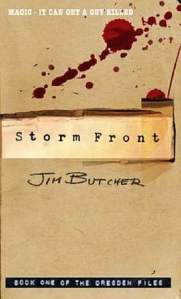 Storm Front by Jim Butcher – I’ve put Storm Front but in reality the whole Dresden Files series has had a massive impact on me. To date this is the longest series of books I’ve ever read by a single author. I’ve read more books by Stephen King and some other writers, but they’ve not been parts of a much larger story. In my opinion Jim Butcher is the best architect I’ve ever read. He spends a lot of time planning his novels and he’s done lots of interviews online if you want more info about how he does this. But in short he lays out the structure, works out the ebb and flow and the character arcs so that he knows exactly where he is going with the story. From speaking to some writers I know this approach horrifies them as there is less spontaneous creativity and no veering off down side streets to explore unexpected ideas that crop up during the writing process. The flip side of that is all of his novels have several pay-offs that are really well executed and extremely satisfying for the reader, and when you read the novels one after another, they hang together as a cohesive whole. Despite each novel in the series being a standalone story, each builds on the last as it follows the life of the main character, the wizard Harry Dresden. Butcher has taught me about the benefits of planning a story ahead of time, how subtle foreshadowing can pay off further down the line. He’s also taught me to trust the reader and to respect them. If you start to build towards something then you’d better do it right when the time comes and don’t wimp out or you’ll lose your audience if they can’t trust you. If that means wiping out a favourite character, and it is fitting with the story, then you should do it.
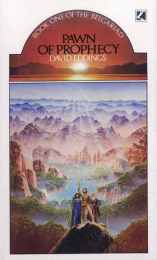 Pawn of Prophecy by David Eddings – When I was ten or eleven I remember seeing my brother reading this book. It wasn’t a big book so I wasn’t intimidated by it and when he told me it was fantasy I was intrigued. Looking at it now, in my thirties, I’m less enamoured by it and can’t read it without wincing, however, at the time it was fresh, exciting, and quite simply a wonderful book. Tolkien is a huge influence on many fantasy and genres writers, and he did have an impact on me, but I think Eddings had a greater influence because I read all of the Belgariad and then years later the Mallorian and several other books by him. I spent more time immersed in the worlds that he created and I spent a lot more time with his characters than Tolkien. I felt like Garion was someone I could see wandering the hallways of my school and I really wanted an aunt like Polgara and a grumpy old grandpa like Belgareth. By this time Tolkien had already passed away, so in my mind (at the time when I was eleven) he was old-fashioned fantasy, whereas Eddings was current and writing it for me, right now! Eddings gets a lot of grief from some quarters, and I think some aspects of the criticism are valid, however he was instrumental in my early reading and my love of the fantasy genre, so he definitely deserves to be on this list. These are definitely books to give to younger readers, pre YA even, to ease them into the fantasy genre.
 Dune by Frank Herbert – There are some really amazing books, like certain TV shows, films, comedians or even individual comedic sketches, that people will quote for decades after the fact. Monty Python hasn’t been on TV for a long time but people still quote the Dead Parrot sketch, the Knights of Ni from the Holy Grail film, bits from the Life of Brian and so on. This book not only spawned several sequels by Frank Herbert, but it also generated several prequels written by his son and Kevin J. Anderson several decades later. The book has also been adapted into one film and, in my opinion, one really good mini TV series. Regardless of the quality of the sequels and the other spin-offs and adaptations, the ideas in this book are vast and the ground so fertile and rich, with ideas that they need exploring. The material is so interesting and so thought provoking and unique, that I still quote sections, ponder some of the decisions made and I also re-read it. The latter might sound like no great achievement, but there are so many books being published nowadays, and there are so many other distractions vying for my attention and my time, that to actually go back and reread a book is something I almost never do anymore. What Herbert did with Dune is expand my horizons and make me think beyond not only myself and my life, but beyond Earth to the future of mankind and what we, as a species, might accomplish if we ever stopped looking inwards so much and went out there to the stars. It also exposed me to ideas that were so big I couldn’t really grasp them at the time. The first time I read Dune I was too young and I knew I was missing some of the nuances and other material that was there between the lines. It’s such a rich and fertile universe that I just love spending time there and going on an epic journey with Paul. The other incredible thing is that this book hasn’t aged and someone reading it for the first time in 2012 would be as gripped as someone who read it in the 1960s or 1980s. The power of some classic SF novels has diminished, not just because of the advances in technology, but also because the world went in a different direction.
 The Green Mile by Stephen King – I first read this in 1996 when it was still coming out in a serialised fashion. I was working in the USA for a summer and on the regular trips into town with my roommates I would regularly check the book store to see if the next installment had come out. You can buy it as a complete novel now, but back then King was releasing in approx six 100 page little booklets. It wasn’t my first King book by that time, but it is the one with which I connect the most. I’ve read many King books, not all of them, and some I’ve enjoyed more than others, but this is still my favourite King novel by a long distance. It’s been more than fifteen years since I read it and I’m still thinking about it. The man is an amazing storyteller and in my opinion he excels at characterisation and making the impossible and the unreal and the scary seem very possible. This is also one of the most emotional novels I’ve ever read and although the phrase rollercoaster is over used, the story took me through a huge range of emotions. This is an incredibly powerful novel about love, loss, the human spirit, sacrifice, compassion, cruelty and miracles. It really puts you through the emotional wringer and for me it is an incredible and very moving book. I should also point out that it is rare that a film adaptation of a novel is very good. The Green Mile by Frank Darabont is one of the exceptions and the film is one my favourites of all time. It’s just that good. For those who are unsure about Stephen King, I always recommend this book over his others.
 Odd Thomas by Dean Koontz – I came to Koontz quite late and I took a risk on him, because at the time, I’d not heard much about him. I was browsing a book shop and I lamented to a friend there was nothing new in the SFF section that looked very interesting. She told me to try another genre, so in a slight huff I wandered slightly to my right into the horror section and started reading the back of several books. This was my first Koontz novel but definitely not my last. Some of Koontz’s novels are brilliant and some I haven’t enjoyed, but I’ve now probably read 90% of his back catalogue. In terms of sheer creativity and the breadth of ideas, the man is a genius. He starts with a tiny seed of an idea on a card, often just a few sentences, and from that he turns it into a gripping and spellbinding story. He doesn’t plan, he does it all as he goes along completely organically and most of the time he’s successful in making the story a cohesive whole. Only a few of his novels are huge doorsteps and he taught me about economy of words and that you don’t need to waffle on and on to get the message across. Like King he also taught me that using an everyday word is often far better than something you’ve picked out of the thesaurus. He also taught me about conveying character through dialogue. Odd Thomas is a spooky, weird, and gripping story which starts from a slightly familiar premise but Koontz then takes it in a very unique direction. This novel proved to be so popular that he’s gone on to write several more with the same character, which is something of a rarity for him that he’s only done on a couple of occasions in his career, so it shows you there was something very special about this first one.


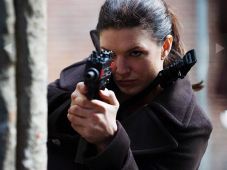 Gina Carano – We all agreed on Bags of Action that she was amazing in Haywire. You knew that she was doing most (if not all) of her own stunts and every fight scene was her and not someone else. You completely believed that her character Mallory was someone who was very capable of looking after themselves in any situation. No doubt it comes from her own physicality, because of her MMA background and even her time on American Gladiators. Cheesy as the TV show might be, as was the British equivalent, all of the gladiators were fit and athletic people.
 Cynthia Rothrock – She is a veteran of dozens of martial arts films and undoubtedly would fill the Sly Stallone role in The Expendables, perhaps pairing up with Gina Carano, as Sly pairs with The Stathem. Although she officially retired from action movies, many of her contemporaries (Norris, Stallone, Schwarzenegger, Van Damme) have recently returned to major action roles after many years away. So perhaps someone could persuade her to come back if such a film were ever made.
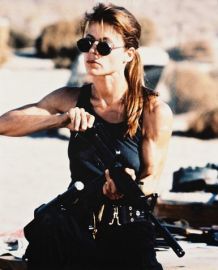 Linda Hamilton – Unashamedly I’m a big fan of the Beauty and Beast TV series from the late 1980s starring Linda Hamilton and Ron Perlman. It was must see TV for me growing up, and I then saw her next in The Terminator. It was only after seeing her in T2 that I had to completely reassess my view of her as an actress. Gone was the gentle, softly spoken, curvy, kind and caring person and in it’s place was this tough, stringy, cigarette smoking, gun-toting, driven and determined soldier. I like T2, despite being very silly in places, but if you look at her role in T2 in isolation, it’s powerful, disturbing and believable as someone who has been locked up because of her delusions about killer robots from the future.
 Sigourney Weaver – There’s not much I have to write about her really other than Alien franchise. She’s done it all. She is an incredibly talented actress who has played a wide variety of characters and continues to do so (I’m really looking forward to seeing her in Red Lights), but never was she more terrifying than Ellen Ripley.
 Ali Larter – This is one of my choices and there again she started off with a couple of roles where she was often running and screaming in front of the camera (Final Destination) but since then she’s portrayed a wider variety of characters. From Resident Evil, to international fame in Heroes as a fairly dark character, to a femme fatale in Obsessed. I think she would be a great addition to the action team.
 Two others I would be remiss if I didn’t mention are Cobie Smulders, who did a great turn as Maria Hill in a little film called The Avengers, and Scarlett Johansson who was also very good as Natasha Romanoff. Cobie Smulders is an interesting actress as previously when Joss Whedon was briefly attached to write and/ or direct a Wonder Woman film for DC comics, I believe his choice for Wonder Woman was Cobie Smulders. She’s extremely accomplished as a comedic actor, as her body of work in ‘How I Met Your Mother’ shows, but in The Avengers we get to see a tougher character in a position of authority.
 into every episode, preparation for interviews, gathering news etc, and then the post-show work, editing, uploading and distributing. The only thing I need to do for this podcast is watch a movie. We’re recording the first episode later this week, so it will be out in another week or so. You can follow Bags of Action on
  approaches it. I enjoy talking to other writers and finding out how they create and hopefully this podcast will provide interesting food for thought for myself and other writers out there. In episode 1 I spoke with Lou Morgan and you can visit the Head Space blog here (it will soon be available on iTunes under its own name if you want to subscribe there), to download the podcast. We talk about her debut book, Blood and Feathers from
  Stephen Aryan
You must be logged in to post a comment.